
In recent years, Nepal’s monsoon has become increasingly erratic, and the year 2082 BS (2025 AD) stood out as a year of prominent contradictions and unpredictability. The monsoon arrived ahead of its onset date and withdrew later than the average withdrawal date. Across rural Nepal, communities experienced a monsoon unlike any other, they faced drought-like conditions during the rice planting season to intense rainfall during the harvest season, followed by devastating disasters such as floods and landslides. This anomalous pattern increases the risks of monsoon-related disasters and exposes the aggravated fragility of rural communities.
Double hazards: How women bear the brunt of drought and floods
Within a single monsoon season, Nepal swung from drought-like conditions in the fourth week of July with delayed rice planting due to inadequate water availability to subsequent devastating flood events that caused severe damage to farmlands, homes and infrastructures in the first week of October across various parts of the country, including Kavrepalanchok and Sindhuli districts. This calamitous event left many marginalised communities, especially smallholder farmers, vulnerable and uncertain about their livelihoods, as it impacted crop productivity due to drought-like conditions and compounded losses due to inundation of standing crops.
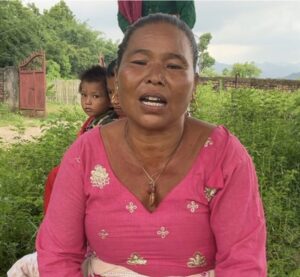
As with other impacts of climate change, these erratic rainfall patterns and the consequent loss of harvest affected the women of these vulnerable communities the most. Ramri Maya Theeng (52) from Chayachuti, Hariharpurgadi, Sindhuli had heard of the above-average rainfall forecast in the news, but the actual rainfall during the paddy plantation season was extremely low. She was worried that she would not be able to plant anything at all this year, which would leave her family struggling to meet their needs throughout the year.
Ramri Maya usually harvests 40-45 muri (1 muri=50kg) of paddy from leased lands near the Marin riverbank, which costs her NPR 2000 annually. Despite being so close to the river, Ramri Maya’s fields remained dry due to a lack of irrigation infrastructure and facilities. She could not rely on rainwater as the rain-fed farming has become increasingly unreliable due to the untimely and unpredictable monsoon rainfall.
In Methinkot, Namobuddha Municipality-04 of Kavrepalanchok, the situation was equally dire. Bimala Chimauriya (46), from Methinkot, Kavrepalanchowk, shares that water scarcity has worsened over the past decade, while erratic rainfall and limited water supply have made local people’s daily life increasingly difficult.
“Water has become scarcer in our village. There is not enough rainfall. Water scarcity has made our daily household chores increasingly challenging. Drinking water is supplied only for a couple of hours once a week. On top of that, the water supply schedule is uncertain, which compels us to spend more time waiting for water. If we miss tapping that water, we face water scarcity for basic use, such as cooking, for the whole week.” Bimala shares.
The drastic shift: From scarcity to floods
When people assumed that the lack of rainfall resulting in the growing crisis of water scarcity and their inability to cultivate in their farmlands were their biggest challenges, climate unpredictability unleashed another bigger challenge, adding to their woes. Relentless rainfall increased around the monsoon’s withdrawal time in early October. Uninterrupted, Continuous torrential rainfall triggered nationwide massive disasters, including floods and landslides.
Ramri Maya shares her double trouble:
“This year, we faced water scarcity and then sudden floods. Our farmland went from being parched to inundated. We had to rush through harvesting and threshing the rice by mid-October, working day and night, while still managing household chores. Due to unexpected rainfall for five days, the harvests were nearly ruined. If these events keep repeating, we will not be able to feed our families.”
For many of the women in the communities, these burdens added by the climate crisis are solely theirs to carry. They must manage the added chores and responsibilities in addition to their regular duties. Their lack of knowledge and understanding of why the weather patterns are changing and how to cope with these changes further aggravates their plights. Ramri Maya had never heard about climate change until recently; it was only after attending the Women Learning Centre’s meeting that she came across these terms.
“What we learned at the Women Learning Centre meetings about topics like climate change and disasters, it’s all coming true. Back then, it felt like just information. But now, we’re living it. The future looks frightening.” She then added “In our recent monthly meeting, we raised our concerns and discussed with fellow members about how women’s woes intensifies during disasters.”
These stories reveal the lived experiences of rural people who face the effects of climate change with limited resources and support. Their livelihoods, heavily dependent on farming and seasonal rainfall, was critically hampered, highlighting the urgent need for climate-resilient infrastructure like irrigation systems, early warning systems, and support for smallholder farmers like Ramri Maya.
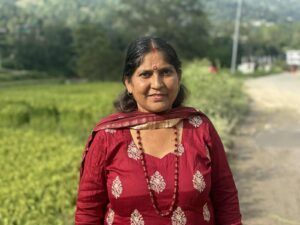
In Methinkot, the monsoon season triggered a landslide that damaged water sources and disrupted municipal water supply, worsening an already fragile situation. Water scarcity, which was a concern even before, became critical, more so after the disaster. It is always the women of the communities who have to step in to take on the added burden when such climate-induced scarcity takes place. Women are either forced to fetch water from their neighbouring village by walking for a couple of hours or depend upon the limited weekly water supply for a short amount of time.
“We are solely responsible for water collection and household management. It is so inadequate that our agricultural activities have been limited, leaving our farmlands barren and unproductive most of the time. If there were an irrigation facility, we could be self-reliant on vegetables and earn income by selling them,” shared Bimala.
Women who often carry the responsibility of water collection and management, as per traditional gender roles, face physical strain from carrying heavy loads over long distances and heightened health risks when water is scarce or inaccessible. This situation reflects structural inequalities where women remain trapped in domestic roles. Their unpaid labour increases with added workload and limited economic empowerment.
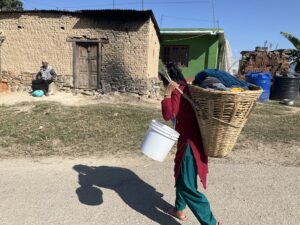
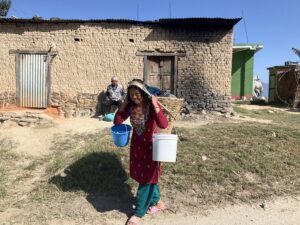
A woman carrying a bamboo doko (basket) full of washed clothes from spring away from her home in Methinkot, Namobuddha Municipality
Gendered realities and the need for inclusive action
The burden of climate risks and crises is not shared equally. Women, especially in rural areas, face the disproportionate impacts and burden from climate risks due to their roles as caregivers, food producers and water managers. Moreover, as climate extreme events become more frequent and unpredictable, stories of rural women from Sindhuli and Kavrepalanchok districts, like Ramri Maya and Bimala, showcase the urgent call to action.
Their stories are not isolated. They reflect a broader gendered reality where women are the frontline responders to climate shocks with increased workload and access to the fewest resources. Their safety and well-being are often compromised, and their concerns extend far beyond crop yields or daily water needs. They worry about sustaining their families, managing scarce resources and protecting themselves and their families.
This is why the need for gender-responsive approaches in climate adaptation planning and recognising the unequal burden on women is not just important, it is urgent. Recognising the unfair burden on women and ensuring their leadership and participation in climate decision-making must be central to a meaningful response. Their lived experiences, knowledge and resilience must shape policies and initiatives to build inclusive and effective climate responses.
A pattern of unpredictability and economic losses
The years 2024 and 2025 have revealed a distressing trend of climate unpredictability in Nepal. The severe and unusual events, for instance, drought-like conditions during the onset of monsoon and intense rainfall during the withdrawal of monsoon, seemed to deviate from the norm in the past couple of years.
In 2024, widespread destruction of infrastructure and economic losses due to floods and landslides were estimated at NPR 46.68 billion as per a preliminary assessment by the National Disaster Risk Reduction and Management Authority (NDRRMA). While, in contrast, early 2025 brought prolonged dry spells, above-normal temperatures, disrupted seasonal rainfall patterns leading to drought-like conditions, and agricultural stress. While the heavy rainfall in early October caused billions of losses to infrastructure, economic losses and caused losses of NPR 3.5 billion in the agriculture sector alone, as per the Ministry of Agriculture and Livestock Development (MoALD).
The unpredictability of the monsoon in 2024 and 2025, and the billions of losses to infrastructure, energy, agriculture sectors, etc., may seem to hint at a troubling pattern for Nepal and its local communities, who are already living on the edge of vulnerability. These frequent and intense climate-induced disasters hit women hardest, especially those dependent on the agriculture. Women-headed households face compounded barriers in accessing relief, credit and livelihood opportunities. Care-giving burdens also surge during disasters, further limiting their income opportunities and mobility.
A wake-up call for Nepal
The recent monsoon crisis is a warning for Nepal that the future is even more dangerous and deeply gendered without gender-sensitive climate policies and interventions. By integrating infrastructure, early warning systems, mobilising financial support, and education, we can build and strengthen rural communities’ resilience and equip them to face and thrive in the face of a changing climate.
For instance, investing in climate-resilient infrastructure in rural Nepal that withstands climate variability and disasters while supporting sustainable livelihood is significant at this time. This saves women time and physical effort in fetching water, and reduces stress on women farmers who manage their farms. Similarly, strengthening infrastructures that integrate early warning systems and safe shelters can save lives and reduce losses during disasters like floods, landslides and droughts. Supporting smallholder farmers through climate insurance, women-friendly climate-smart technologies, and emergency relief funds will help secure livelihoods, reduce vulnerability and empower communities through locally-led adaptations.
Nobody should be thirsty for drinking water or uncertain about their next harvest. From ground level in climate adaptation and mitigation measures to disaster preparedness and response, local communities should be strengthened, supported with the needful resources and knowledge.
From commitment to action
To make it happen, local, provincial, and national authorities must invest in climate-resilient infrastructure like irrigation systems, flood barriers and safe water access. They should establish and strengthen early warning systems in vulnerable rural districts and support smallholder farmers through climate insurance, access to climate-smart technologies and emergency relief funds. There is an urgent need to mobilise climate finance to advance locally led adaptation and disaster preparedness initiatives. It is equally important to promote awareness and education programs that empower communities to understand and act on climate risk. Finally, implementing gender-responsive budgeting for climate adaptation must be practised to ensure that resources reach those most affected. Gender-responsive and climate-responsive action are not just essential, they should be integrated into the present as well as plans and programs. It must begin now, this minute, this second.
Sabitri Rai serves as the Project Coordinator at Clim Adapt for the initiative titled “Building Women’s Climate and Disaster Resilience by Strengthening Climate Smart Villages for Increased Gender-responsive Climate and DRR Actions,” supported by the UN Women.